Showing posts with label Sunni. Show all posts

Thursday, September 4, 2014

Hadith Narrated by 'Ali ibn Abi Talib: Part III


It was narrated by 'Affan from Shu'ba, reported by 'Ali ibn Mudrik, who said: I heard Abu Zur'a ibn 'Amr ibn Jarir who narrates from 'Abdullah ibn Nujay from his father from 'Ali from the Prophet, that he [the Prophet] said: 'The angels do not enter a house in which there is a dog or an image.'
Hadith #815, Musnad Ibn Hanbal

It was narrated by 'Abdullah from Salih ibn 'Abdullah al-Tirmidhi from Hammad from 'Asim from 'Ubaydullah al-Qawariri from Hammad, who [al-Qawariri] said in his report, from 'Asim ibn Abu al-Najud from Zirr, meaning Ibn Hubaysh, from his father Juhayfa, who said: I heard 'Ali say: 'Shall I not tell you of the best of this Umma after its prophet [Muhammad]?  [It is] Abu Bakr.'  Then he said: 'Shall I not tell you of the best of this Umma after Abu Bakr?  [It is] 'Umar.'
Hadith #833, Musnad Ibn Hanbal

It was narrated by Muhammad ibn Ja'far from Shu'ba from Salama ibn Kuhayl from al-Sha'bi that 'Ali flogged Shuraha on Thursday and stoned her [to death] on Friday. saying: 'I flogged her in accordance with the Book of God [the Qur'an, for adultery] and stoned her in accordance with the sunna of the Messenger of God.'
Hadith #839, Musnad Ibn Hanbal

It was narrated by 'Abdullah from Muhammad ibn Sulayman al-Asadi Luwaun from Yahya ibn Abu Za'ida from 'Abd al-Rahman ibn Ishaq from Ziyad ibn Zayd al-Suwa'i from Abu Juhayfa from 'Ali, who said: 'It is from the sunna [of the Prophet] that in prayer one places one hand over the other beneath the navel.'
Hadith #875, Musnad Ibn Hanbal

It was narrated by Asud ibn 'Amir from Shu'ba, who said: The command reported from Abu Muhammad from 'Ali, who said the Prophet sent him to Madina and commanded him to level the graves.
Hadith #881, Musnad Ibn Hanbal

 It was narrated by Ishaq ibn Ibrahim al-Razi from Salama ibn al-Fadl from Muhammad ibn Ishaq from Zayd ibn Abu Habib from Marthad ibn 'Abdullah al-Yazayni from 'Abdullah ibn Zubayr al-Ghafa'i from 'Ali ibn Abi Talib that the Messenger of God used to ride a donkey named 'Ufayr.
Hadith #886, Musnad Ibn Hanbal

It was narrated by Husayn ibn al-Hasan al-Ashqar from Ibn Qabus ibn Abu Zabyan al-Janbi from his father from his grandfather from 'Ali, who said: 'When I killed Marhab [ibn Abu Zaynab, a chief of the Arab Jewish Khaybar Oasis tribes killed in the Battle of Khaybar], I brought his head to the Prophet (lama qataltu Marhab jintu bi-rasihi ila al-Nabi).'
Hadith #888, Musnad Ibn Hanbal

It was narrated by 'Abdullah from Shayban Abu Muhammad from Hammad ibn Salama from Yunus ibn Khabbab from Jarir ibn Hayyan from his father that 'Ali said to his father [Ibn Khabbab's]: 'I shall certainly send you on the same [type of] mission as the Messenger of God  sent me on: Level every grave and destroy every idol.'
Hadith #889, Musnad Ibn Hanbal

It was narrated by 'Ali ibn Bahr from 'Abdullah ibn Ibrahim ibn 'Umar ibn Kayyan,m who said of his father, I heard him report that 'Abdullah ibn Wahb from his father from Abu Khalifa from 'Ali ibn Talib, who said the Messenger of God said: 'God is kind and loves kindness, and He rewards kindness in a way that He does not reward harshness.'
Hadith #902, Musnad Ibn Hanbal 


Sunday, August 24, 2014

Hadith Narrated by 'Ali ibn Abi Talib: Part I


It was narrated by Waki'a from Sufyan from Habib from Abu Wa'il from Abu al-Hayyaj al-Asadi, who said: 'Ali said to me, 'I shall send you on the same mission as that on which the Messenger of God (upon him be peace) sent me [Ab'athuka 'ala ma ba'athani 'alayhi Rasul Allah]: Do not leave any image without erasing it [an la tada'a timthala-an ila tamasta-hu] and any elevated (ornate) grave without leveling it [wa la qabr-an mushrifa-an ila sawwayta-hu].
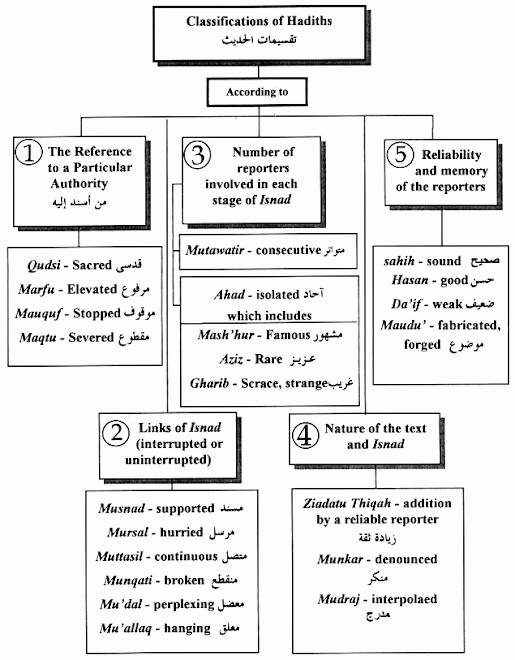
Hadith #741, Musnad Ibn Hanbal (in the Musnad 'Ali ibn Abi Talib); sahih isnad

It was narrated by Waki'a from Sharik from Simak from Hunash from 'Ali, who said: The Messenger of God (upon him be peace) said: 'If two individuals engaged in a dispute sit before you, do not speak until you have listened to the second one in the same way as you have listened to the first.
Hadith #745, Musnad Ibn Hanbal (in the Musnad 'Ali ibn Abi Talib); hasan hadith, da'if isnad

It was narrated by Muhammad bin Ishaq from Yazid bin Abu Habib from 'Abd al-'Aziz bin Abu al-Sa'aba from 'Abdullah ibn Zurayr al-Ghafiqi, who said: I heard 'Ali say: 'The Messenger of God (upon him be peace) held some gold in his right hand and some silk in his left hand; he then raised both his hands and said: 'These two things are forbidden for the men of my Umma.'
Hadith #750, Musnad Ibn Hanbal (in the Musnad 'Ali ibn Abi Talib); sahih hadith

It was narrated by Muhammad bin Ja'far from Shu'ba from Abu Ishaq from Najiyya bin Ka'b, who reported from 'Ali, who  came to the Prophet (upon him be peace) and said: 'Abu Talib has died.'  The Prophet (upon him be peace) said: 'Go and bury him.'  'Ali then said: 'He died a mushrik.'  He [the Prophet] said: 'Go and bury him.'  'Ali then said: 'When I had finished burying him, I came back to the Prophet (upon him be peace) and he said, 'Do ghusl.' '
Hadith #759, Musnad Ibn Hanbal (in the Musnad 'Ali ibn Abi Talib); sahih isnad

 It was narrated by Muhammad bin Ja'far from Sa'id...Abu 'Aruba...from al-Hakam bin 'Utayba from 'Abd al-Rahman bin Abu Layla from 'Ali ibn Abi Talib, who said: 'The Messenger of God (upon him be peace) instructed me to sell two slave brothers [ghulamayn akhawayn], so I sold them, but separately [fa-bi'tuhuma wa farraqtu baynahuma].  I mentioned this to the Prophet (upon him be peace) and he said: 'Go and find the two of them, take them both back, and do not sell them except together.'
Hadith #760, Musnad Ibn Hanbal (in the Musnad 'Ali ibn Abi Talib); hasan hadith, da'if isnad due to it being broken/munqaṭiʻ


Saturday, August 23, 2014

Hadith on Jihad: Part II


"Imam al-Sadiq said: 'He who is slain in the path of God will not recount anything of his sins [his sins will be forgiven]."
-Hadith from Furu' al-Kafi, vol. 5

"It was narrated by Abu Zakariyya Yahya bin Durust (al-Basri) from Abu Isma'il from Yahya bin Abu Kathir from Abu Salama from Bushr bin Sa'id from Zayd bin Khalid al-Juhani from the Messenger of God (upon him be peace], who said: 'Who so ever prepares a ghazi in the path of God, it will be as if he has participated in a military expedition (faqad ghaza), and who so ever looks after the family of a ghazi, it will be as if he has participated in a military expedition (faqad ghaza)."
-Hadith #1628 from the Jami' of al-Tirmidhi (sahih hadith)

Friday, August 22, 2014

Hadith on Jihad: Part I


"It was narrated from Abu Bakr bin Abu Shayba and Abu Kurayb, who said: It was narrated from 'Ubaydullah bin Musa from Shayban from Firas from 'Atiyya from Abu Sa'id al-Khudri from the Messenger (upon him be peace): 'The mujahid in God's path has a guarantee from God.  Either He will raise him [the mujahid] to His forgiveness and mercy, or He will send him back with a reward [ajr] and war spoils [ghanima].  The example of the mujahid in God's path is that of one who fasts and prays at night without stopping, until he returns."
Sunan Ibn Majah, hasan hadith 2754 

"It was narrated by Abu Bakr bin Abu Shayba from Yunus bin Muhammad from Layth bin Sa'd from Yazid bin 'Abdullah bin al-Had from al-Walid bin Abu al-Walid from 'Uthman bin 'Abdullah bin Suraqa from 'Umar bin al-Khattab, who said: 'I heard the Messenger of God (upon him be peace) say:' 'Whoever equips a ghazi in the path of God until he is fully equipped and supplied will have a reward like his [the ghazi], until he dies or returns.'"
Sunan Ibn Majah, sahih hadith 2758

"It was narrated from Hisham bin 'Ammar from 'Abd al-Rahman bin Zayd bin Aslam from Abiya from Mus'ab bin Thabit from 'Abdullah bin al-Zubayr, who said: 'Uthman bin 'Affan addressed the people  and he said, O' People!  I heard a hadith from the Messenger of God (upon him be peace) and nothing kept me from narrating it to you except for the fact that I did not want to lose you and your companionship.  So it is up to you.  I heard the Messenger of God (upon him be peace) saying, 'Whoever spends a night guarding the frontier [man rabata laylatan fi sabil Allah] in the path of God, it will be like a thousand nights spent in fasting and prayer [kanat ka-alf laylat siyamiha waqiyamiha].'"
Sunan Ibn Majah, da'if hadith 2766

Wednesday, July 9, 2014

Hadith on Shrines as Places of Worship from Sahih al-Bukhari


وَأَخْبَرَنِي عُبَيْدُ اللَّهِ بْنُ عَبْدِ اللَّهِ بْنِ عُتْبَةَ، أَنَّ عَائِشَةَ، وَعَبْدَ اللَّهِ بْنَ عَبَّاسٍ، رضى الله عنهم قَالاَ لَمَّا نَزَلَ بِرَسُولِ اللَّهِ صلى الله عليه وسلم طَفِقَ يَطْرَحُ خَمِيصَةً لَهُ عَلَى وَجْهِهِ، فَإِذَا اغْتَمَّ كَشَفَهَا عَنْ وَجْهِهِ وَهْوَ كَذَلِكَ يَقُولُ ‏ "‏ لَعْنَةُ اللَّهِ عَلَى الْيَهُودِ وَالنَّصَارَى، اتَّخَذُوا قُبُورَ أَنْبِيَائِهِمْ مَسَاجِدَ ‏"‏‏.‏ يُحَذِّرُ مَا صَنَعُوا‏.‏

Hadith #4443, Kitab al-Maghazi (Military Expeditions of the Prophet Muhammad), Sahih al-Bukhari: 

Narrated from 'Ubaydullah bin 'Abdullah bin 'Utba, 'Aisha, and 'Abdullah ibn 'Abbas, may God be pleased with them: They said: "When God's Messenger became seriously ill, he started to cover his face with his woolen sheet, and when he felt short of breath, he removed it from his face and said, "That (this) is so.  May God curse (God's curse) be upon the Jews and the Christians [who have taken] took the graves of their prophets [as] places of worship; he intended to warn [the Muslims against] what they had done."

This hadith is mawquf (attributed to one of the Sahaba).  A version of this hadith also appears in Sahih Muslim.

Friday, April 25, 2014

Grand Ayatullah Bashir Najafi's Message to the 27th International Islamic Unity Conference in Tehran


MESSAGE OF HIS EMINENCE THE GRAND AYATOLLAH SHEIKH BASHEER HUSSIEN AL-NAJAFY IN THE TWENTY SEVENTH INTERNATIONAL ISLAMIC UNITY CONFERENCE IN TEHRAN


9 Rabeeul Awwal 1435 AH – 11 January 2014 AD
No. 39

In the name of Allah, the most gracious, the most merciful

        Praise and thanks are due to Allah for guidance to His religion and way. Peace and blessings are up on the master of the two universes and the holder of the best law to humans Mohammad Bin Abdullah and his immaculate progeny, and permanent cures is on their enemies till the Day of Judgement.
      Allah (the glorious) says "You are the best nation produced [as an example] for mankind. You enjoin what is right and forbid what is wrong and believe in Allah"
        The Islamic law assigns the Muslim many liabilities. The most important two are: The first is reforming the relationship between the Muslim and Allah through worshiping and obeying His Messenger and successors. The second is the relationship among the slaves of Allah. In this conference, we focus on the second issue as the title of the conference indicates. Allah is the all helper.
         This relationship is divided into two parts: those who follow the religion of Islam and those who disagree with Muslims according to their religions or sects.
        In the first type of relationship, Muslims, as manifested in the holy Quran, should pay attention to blend in and live peacefully without affecting other's freedom. Rather, Muslims should attempt to create rapprochement among Muslims regardless to their religious, sectarian, national, or spatial differences. The holy Quran advises us to do this as in the holy verse "The believers are but brothers, so make settlement between your brothers. And fear Allah that you may receive mercy". This eloquent discourse urges us to create the spiritual connection in a way that it becomes important to every Muslim's life. This can be achieved once the self is reformed. Allah says "O you who have believed, let not a people ridicule [another] people; perhaps they may be better than them; nor let women ridicule [other] women; perhaps they may be better than them. And do not insult one another and do not call each other by [offensive] nicknames. Wretched is the name of disobedience after [one's] faith. And whoever does not repent - then it is those who are the wrongdoers". The Holy Quran urges us to abide by the Islamic tenets regarding this issue. Allah says "But if they had done what they were instructed, it would have been better for them and a firmer position [for them in faith]". Allah also orders us to have rapport, mutual cooperation and support, as in the holy verse "And if they seek help of you for the religion, then you must help, except against a people between yourselves and whom is a treaty. And Allah is Seeing of what you do". Therefore, Allah praises the loyal people in the verse "And the first forerunners [in the faith] among the Muhajireen and the Ansar and those who followed them with good conduct - Allah is pleased with them and they are pleased with Him, and He has prepared for them gardens beneath which rivers flow, wherein they will abide forever. That is the great attainment". Accordingly, Allah considers the Muslim who is truly loyal as a loyal slave to Him "O you who have believed, if you support Allah , He will support you and plant firmly your feet". Muslims, nowadays, are facing many challenges. The reasons of which are as follows:
1.     Psychological factors, emerging from immoral drives, and inattention to the effect of these factors that are disuniting the nation.
2.     Manipulating with connotations of the Holy Quran in order to spread out the corrupting ideas for implanting the hatred and grudge among one another.
3.     Accusing one another of blasphemy, atheism, and polytheism as what is happening nowadays in Iraq, Syria, Libya and other places.
4.     Political reasons to obtain some privilege and forgetting about the horrible consequences of this. 
         This predicament requires thinkers, on the one hand, and the leaders of Islamic countries, on the other hand, to be serious in preventing the spread of evil that we have mentioned.
       It should be starting out from reforming evil represented by anathematizing Muslims among one another, and spread out to interfere in the social and religious affairs of other countries. The fact is that the Islamic anathema has become one of the most demoralizing acts nowadays. What heinous acts within terrorism we see in a number of Muslim countries is only an inevitable consequence of the hating Anathema (Takfeer).  Thus, religious authorities and state leaders have to prevent the issuance of religious verdicts regarding this matter in order to become one united nation: "Indeed, Allah loves those who fight in His cause in a row as though they are a [single] structure joined firmly", and as narrated about the Prophet (PBUH&HP) that he said: ( the believers in their mutual love, mercy and compassion, like one body, if a member complained to falter, the rest of the body gets fever).
        The second type of relationship is how the Islamic nation deals with other doctrines. If we were able to fix what caused the dispersion and fragmentation, we, then, would be able to communicate with others very easily, because Allah Almighty has promised us of victory if we support and get loyal to Him in His religion. Therefore, we should show the True Islam to the humans as a whole, the true religion that carries the right and is characterized by seeking the extension of Justice, which is the wish of all peaceful humans.
         Since Islam is a religion in conformity with instinct, its spreading among humans was easy, and if Islam spread on the earth; the Islam which is void of Takfeer (Islamic anathema), and Muslims had no grudge among one another, the world would have been better than now. Peace will be spread to all mankind in the world and the divine promise will be achieved: "When the victory of Allah has come and the conquest, And you see the people entering into the religion of Allah in multitudes, Then exalt [Him] with praise of your Lord and ask forgiveness of Him. Indeed, He is ever Accepting of repentance" , and the soul of the Prophet (PBUH&HP) and all the souls of Mujahideen for the sake of Islam will get rejoiced when Allah's promise for His beloved Muhammad ibn Abd Allah (PBUH&HP) is achieved. Allah says:"So what yet causes you to deny the Recompense? Is not Allah the most just of judges?"
________________________________

كلمة سماحة آية الله العظمى المرجع الديني الكبير الشيخ بشير حسين النجفي (دام ظله) في ذكرى المؤتمر الدولي السابع والعشرين للوحدة الإسلامية/ في طهران

بِسْمِ اللهِ الرَّحْمنِ الرَّحِيمِ
الحمد لله على هدايته لدينه، وله الشكر على ما دعا إليه من سبيله، والصلاة والسلام على سيد الكونين حامل أفضل شريعة للخليقة إلى يوم الدين، محمد بن عبد الله وعلى آله الغر الميامين، واللعنة على أعدائهم أجمعين إلى يوم الدين.
قال الله سبحانه: (كُنتُمْ خَيْرَ أُمَّةٍ أُخْرِجَتْ لِلنَّاسِ تَأْمُرُونَ بِالْمَعْرُوفِ وَتَنْهَوْنَ عَنِ الْمُنكَرِ وَتُؤْمِنُونَ بِاللّهِ).
صَدَقَ اللَّهُ الْعَلِيُّ الْعَظِيمُ
أن الشريعة الغراء تحمل كل مسلم مسؤوليات كثيرة، وأبرزها إصلاح العلاقة بينه وبين الله سبحانه من خلال عبادته وطاعته وطاعة رسوله وأولياءه، والثانية العلاقة بينه وبين العباد، ونحن في هذا المؤتمر الموقر نحاول إبراز الاهتمام بالثاني، كما يقتضيه عنوان المؤتمر، ومن الله التوفيق.
وتنقسم العلاقة الی قسمين:
احدهما: علاقته مع أبناء جنسه وأتباع الدين الإسلامي، والذين يحملون على جباههم وسام الإسلام وتاج الإيمان بالله ورسوله محمد بن عبد الله (ص).
والثانية: علاقته مع الذين يخالفون المسلمين بانتماءاتهم الدينية والمذهبية.
وأما المقام الأول: فيجب على المسلم بمقتضى تعاليم القرآن الاهتمام بخلق الإتحاد والتعايش السلمي بما لا يثير حفيظة الآخرين، بل يجب على الكل السعي في خلق التقارب بين المسلمين على اختلاف انتماءاتهم القومية والفئوية والجغرافية والمذهبية، فأن القرآن يدعونا إلى التآلف والاقتراب، فيما بيننا قال الله سبحانه: (إِنَّمَا الْمُؤْمِنُونَ إِخْوَةٌ فَأَصْلِحُوا بَيْنَ أَخَوَيْكُمْ وَاتَّقُوا اللَّهَ لَعَلَّكُمْ تُرْحَمُونَ)، وهذا التعبير البليغ هو الذي يحثنا على خلق الترابط الروحي بحيث يصبح من مقتضيات حياة كل مسلم النظر والاهتمام بجميع المسلمين قدر المستطاع ويتحقق إذا صلحت نفس السلم تجاه أخيه المسلم: قال سبحانه (لاَ يَسْخَرْ قَومٌ مِّن قَوْمٍ عَسَى أَن يَكُونُوا خَيْراً مِّنْهُمْ وَلاَ نِسَاء مِّن نِّسَاء عَسَى أَن يَكُنَّ خَيْراً مِّنْهُنَّ وَلاَ تَلْمِزُوا أَنفُسَكُمْ وَلاَ تَنَابَزُوا بِالْأَلْقَابِ بِئْسَ الاِسْمُ الْفُسُوقُ بَعْدَ الْإِيمَانِ وَمَن لَّمْ يَتُبْ فَأُوْلَئِكَ هُمُ الظَّالِمُونَ)، والقرآن الكريم حث على الالتزام بما جاء بالتعليمات الإسلامية في هذا الجانب، قال الله سبحانه: (وَلَوْ أَنَّهُمْ فَعَلُواْ مَا يُوعَظُونَ بِهِ لَكَانَ خَيْراً لَّهُمْ وَأَشَدَّ تَثْبِيتاً)، وأمر بالتعاطف والتعاضد والتناصر، قال الله سبحانه: (وَإِنِ اسْتَنصَرُوكُمْ فِي الدِّينِ فَعَلَيْكُمُ النَّصْرُ إِلاَّ عَلَى قَوْمٍ بَيْنَكُمْ وَبَيْنَهُم مِّيثَاقٌ وَاللّهُ بِمَا تَعْمَلُونَ بَصِيرٌ)، ولذلك مدح الله سبحانه النصرة بقوله: (وَالسَّابِقُونَ الأَوَّلُونَ مِنَ الْمُهَاجِرِينَ وَالأَنصَارِ وَالَّذِينَ اتَّبَعُوهُم بِإِحْسَانٍ رَّضِيَ اللّهُ عَنْهُمْ وَرَضُواْ عَنْهُ وَأَعَدَّ لَهُمْ جَنَّاتٍ تَجْرِي تَحْتَهَا الأَنْهَارُ خَالِدِينَ فِيهَا أَبَداً ذَلِكَ الْفَوْزُ الْعَظِيمُ)، فجعل نصرة  المسلم نصرة  له سبحانه فقال تعالی (يَا أَيُّهَا الَّذِينَ آمَنُوا إِن تَنصُرُوا اللَّهَ يَنصُرْكُمْ وَيُثَبِّتْ أَقْدَامَكُمْ)،
والمسلمون اليوم يواجهون تحديات كثيرة ومتنوعة، ويمكن حصر الأسباب فيما يلي:
1) العوامل النفسية الناشئة من الدوافع الغير الأخلاقية، والغفلة عن تأثيرها في تفريق الأمة.
2) التلاعب في مفاهيم القرآن رغبة في نشر الأفكار المنحرفة لحمل البعض ضد البعض.
3) توجيه تهمة الكفر والإلحاد والشرك لبعضهم البعض کما ينطبق اليوم عملياً فی العراق وسوريا وليبيا وغيرها.
4) الدوافع السياسية لكسب بعض المزايا وتناسي عن فضاعة ما يترتب على ذلك.
وهذا المآزق يتطلب من المفكرين من جهة وقادة الدول الإسلامية من جهة أخرى الجدية في الحيلولة دون انتشار المفاسد التي أشرنا إليها.
وينبغي أن يكون التحرك من منطلق إصلاح المفاسد المترتبة على تكفير بعض المسلمين البعض، ويتفرع عليها التدخل في الشؤون الاجتماعية والدينية في الدول الأخرى، والواقع أن التكفير أصبح من أبرز المفاسد الأخلاقية اليوم، وما نشاهده من البشاعة ضمن الإرهاب المنتشر في جملة من البلدان الإسلامية، ما هو إلا نتيجة حتمية للتكفير الممقوت، فعلى مراجع الدين وقادة الدول الحيلولة دون صدور الفتاوى بهذا الشأن لتصبح الأمة جسداً واحداً: (إِنَّ اللَّهَ يُحِبُّ الَّذِينَ يُقَاتِلُونَ فِي سَبِيلِهِ صَفّاً كَأَنَّهُم بُنيَانٌ مَّرْصُوصٌ)، وكما يروى عن النبي (ص) أنه قال: (مثل المؤمنين في توادهم وتراحمهم وتعاطفهم كمثل الجسد الواحد إذا اشتكى منه عضو تداعى له سائر الجسد بالحمى والسهر).
وأما المقام الثاني: وهو تعامل الأمة الإسلامية مع سائر الملل فإذا تمكنا من إصلاح ما سببه التشتت والتشرذم يكون حينئذ التواصل مع الآخرين سهلاً جداً، لأن الله سبحانه قد وعدنا بالنصر إذا نصرناه في دينه، وعلينا حينئذ عرض الإسلام الحقيقي على البرية كلها، وهذا الدين الحنيف يحمل بين طياته جاذبيته التي تتسم بالحق. ويتميز بالسعي في بسط العدل الذي هو أمنية كل ذي مسكة.
وبما إن الإسلام دين يتطابق مع الفطرة كان نشره في البرية سهلاً يسيراً، وإذا أنتشر الإسلام على وجه البسيطة؛ الإسلام الذي يكون خالياً من الدوافع التكفيرية والنوازع الشريرة، وتنزه المسلمون من حقد بعضهم على بعض، كانت الدنيا أفضل مما عليه الآن، ويعم السلام البشرية جمعاء في العالم ويتحقق الوعد الإلهي: (إِذَا جَاء نَصْرُ اللَّهِ وَالْفَتْحُ * وَرَأَيْتَ النَّاسَ يَدْخُلُونَ فِي دِينِ اللَّهِ أَفْوَاجاً * فَسَبِّحْ بِحَمْدِ رَبِّكَ وَاسْتَغْفِرْهُ إِنَّهُ كَانَ تَوَّاباً)، وتفرح روح النبي (ص) وأرواح جميع المجاهدين في سبيل الإسلام حينما يتحقق وعده سبحانه لحبيبه محمد بن عبد الله (ص)، بقوله تعالى: (فَمَا يُكَذِّبُكَ بَعْدُ بِالدِّينِ * أَلَيْسَ اللَّهُ بِأَحْكَمِ الْحَاكِمِينَ). والسلام..

بشير حسين النجفي
النجف الأشرف
9 ربيع الأو

Saturday, July 27, 2013

Shaykh Muhammad ibn Salih al-'Uthaymin on Ramadan


Remarks by the late Saudi Salafi jurist Muhammad ibn Salih al-Uthaymin (1925-2001) on the month of Ramadan.

Wednesday, July 24, 2013

My New Article: "Zaynab's Guardians: The Emergence of Shi'a Militias in Syria"


I have a new article, "Zaynab's Guardians: The Emergence of Shi'a Militias in Syria," in this month's issue of the CTC Sentinel.  The article focuses on 5 main issues: (1) the politics of sectarianism, (2) sectarianization as a gradual, parallel and mutually reinforcing process between communities in conflict, (3) overview of the composition of the militias, (4) ways in which historical memory & idioms are tapped in formulating mobilization frames for social movement creation/mobilization of social movements, & (5) why these frames resonate with the target audience(s).  These are issues which will be a part of my doctoral dissertation and I will be starting to draft more traditionally academic article drafts on some of these issues in relation to these militias and their conceptions and narratives of self-sacrifice and martyrdom (which is a social practice promoted by every community around the globe, most of all the nation-state), funery and commemorative practices, and comparing and contrasting contemporary Sunni and Shi'i Muslim conceptions and narratives of martyrdom.

INTRODUCTION:

"The public emergence of Twelver Shi`a foreign fighter militias operating with Syrian government forces loyal to President Bashar al-Assad, together with the recent public admission by Lebanese Hizb Allah that it is also operating alongside them, is the latest in the increasing sectarianization of Syria’s civil war. Sectarianism has long been a tool used for social and political mobilization by a variety of actors, and has historically been employed as much in struggles within the same community as in struggles between different communities. Historically, sectarianism has been driven by politics and competition over group identity, and has been a part of social processes to mobilize large numbers of people against other groups. This remains true today. As conflicts break down along sectarian or ethnic lines, identifiers (differentiating one group from another)—such as religious affiliation, nationality, or tribe—become increasingly salient. Mobilization frames, which draw upon cultural idioms, are created and utilized to drive social mobilization.

This article examines the gradual sectarianization of the Syrian civil war with a particular focus on the emergence, composition, mobilization frames and media campaigns of pro-Assad Shi`a militias. Close attention is paid to the historical and cultural significance of the mobilization frames and idioms used to inspire support from a broad public, particularly Shi`a, for these groups’ participation. Understanding these frames and their historical and cultural resonance, referred to as “frame resonance” in social movement theory literature, is vital to comprehending the drivers of the mobilization and recruitment of Shi`a foreign fighters in Syria. It finds that these frames, in turn, are the central element at play in the formulation of a sectarian counter-narrative aimed at delegitimizing the Syrian opposition and Sunni rebel groups as well as attracting Shi`a foreign fighters from abroad to fight for al-Assad."

 Read the rest HERE.

There is a typo in this sentence: "For their part, pro-Assad, Sunni rebel groups have drawn upon historical narratives and polemics to counter the information operations and messaging of the al-Abbas Brigade, Hizb Allah, and other Shi`a actors in Syria."

I unfortunately missed this typo during the editing process.  The article went through numerous drafts and edits.  Clearly I did not intend to describe the rebels as pro-Assad, mea culpa. I've contacted the publication's editor-in-chief to see if it can b e fixed in the online version.


Photographic and visual primary sources referenced in the article may be viewed here:
http://occidentblog.wordpress.com/2013/06/24/visual-references/

Saturday, March 16, 2013

Abu Basir al-Tartusi Lecture: Method of Establishing an Islamic State


Abu Basir al-Tartusi (Abu al-Mun'im Mustafa Halima), a prominent Salafi Sunni jihadi religious scholar and ideologue, discusses the process of establishing an Islamic state and why it is necessary.  He speaks in Arabic but a translator then translates into English.  Al-Tartusi is currently in Syria fighting alongside Syrian rebels, including a number of British citizens whom he is alleged to have recruited.

Friday, March 8, 2013

'Abdullah 'Azzam: "Join the Caravan", Part 3: Clarifications about the Issue of Jihad Today


CLARIFICATIONS ABOUT THE ISSUE OF JIHAD TODAY

Praise be to Allah, Lord of the Worlds. Blessings and peace be upon the noblest of Messengers, Muhammad and upon all his family and companions.
1. We have spoken at length about the status of jihad today in Afghanistan, Palestine, and other usurped Muslim lands of the like. We have confirmed what has been agreed upon by the earlier (salaf) and latter (khalaf) generations of hadith scholars, exegetes, jurists, and scholars of religious principles (usul), namely that : "When a span of Muslim land is occupied jihad becomes individually obligatory (fard `ayn) on the inhabitants of that piece of land. The woman may go out without her husband's permission with a mahram, the one in debt without the permission of the one to whom he owes, the child without his father's permission. If the inhabitants of that area are not sufficient in number, fall short, or are lazy, the individually obligatory nature of jihad extends to those around them, and so on and so on until it covers the entire Earth, being individually obligatory (fard `ayn) just like salah, fasting, and the like so that nobody may abandon it."
2. The obligation of jihad today remains fard `ayn until the liberation of the last piece of land which was in the hands of Muslims but has been occupied by the Disbelievers.
3. Some scholars consider jihad today in Afghanistan and Palestine to be fard kifayah. We agree with them in that jihad in Afghanistan for the Arabs was initially fard kifayah. But the jihad is in need of men and the inhabitants of Afghanistan have not met the requirement which is to expel the Disbelievers from Afghanistan. In this case, the communal obligation (fard kifayah) is overturned. It becomes individually obligatory (fard `ayn) in Afghanistan, and remains so until enough Mujahideen have gathered to expel the communists in which case it again becomes fard kifayah.
4. There is no permission needed from anybody in the case of an individual obligation (fard `ayn), according to the principle,"there is no permission necessary for an individual obligation (fard `ayn)".
5. A person who discourages people from jihad is like the one who discourages people from fasting. Whoever advises an able Muslim not to go for jihad is just like the one who advises him to eat in Ramadan while he is healthy and in residence.
6. It is best to shun the company of those who hold back from jihad and not to enter into arguments with them, for this would lead to idle disputation and hardening of the heart. Shaykh al-Islam Ibn Taymiyyah says, "And avoidance comprises: avoiding evil and evil people, and similarly shunning those who call for innovation in religion, and sinful people and those who associate with such people or assist them in those endeavours. Similar is the case of the person who abandons jihad and from whom there is no benefit in associating with, for in this case we are liable to punishment for not having helped him by co-operating in matters of righteousness and piety.
The adulterers, homosexuals, those who abandon jihad, the innovators and the alcoholics, as well as those who associate with them are a source of harm to the religion of Islam. They will not cooperate in matters of righteousness and piety. So whoever does not shun their company is, in fact, abandoning what he has been commanded to do and is committing a despicable deed."

IMPORTANT NOTES REGARDING APPLICATION OF THE ORDINANCE

1. When we call people for jihad and explain to them its ordinance, it does not mean that we are in a position to take care of them, advise them, and look after their families. The concern of the scholars is to clarify the Islamic legal ruling. It is neither to bring people to jihad nor to borrow money from people to take care of the families of Mujahideen. When Ibn Taymiyyah or Al-`Izz Ibn `Abd As- Salam explained the ruling concerning fighting against the Tartars they did not become obliged to equip the army.
2. Carrying out religious obligations is necessary according to one's capability. Pilgrimage, for example, is compulsory on those who are able to perform it.
"And it is an obligation on mankind towards Allah to perform the Pilgrimage of the House for whoever is able to do so."
Similarly, jihad must be performed according to one's ability, as mentioned in the Qur'an,
"There is no blame on the weak, nor on the ill, nor on those who cannot find anything to spend, when they have shown goodwill toward Allah and His Messenger. There is no censure upon the righteous. Allah is Oft-Forgiving, Most Merciful. Nor (is there any blame) on those who, when they came to you to be mounted, you said to them,
" I cannot find anything on which to mount you.' They turned away, their eyes flowing with tears, out of grief that they did not have anything to spend (in the path of Allah)."
Ibn al-`Arabi said,
"This second verse is the strongest of evidence for the acceptability of the excuse of one who is in poverty or has a valid need which holds him back from jihad, provided goodwill has been identified in his conduct while claiming the inability."
Qurtubi said in his tafsir,
"The verse is a basis for the dismissal of obligation from the incapable, so that whoever is incapable of performing a deed is exempted from it, sometimes by doing something else in its place, and sometimes by merely having the resolution and will to do it. There is no difference in this respect between a person who is incapable physically, and one who is financially unable. This verse is explained by the words of Allah, (translated) 'Allah does not impose upon any soul a burden beyond its capability' "
In Sahih Muslim, it is reported that the Prophet (may Allah bless him and grant him peace) said,
"In Madinah are people who are with you whenever you travel any distance or traverse a valley. They were held back by (valid) excuses."
According to another narration, "they were held back by illness."
Qurtubi said,
"The majority of scholars are of the view that anybody who cannot find anything to spend in jihad is not obliged to spend."
Tabari inferred,
"There is no blame (i.e. sin) on those with chronic diseases, who are incapable of travelling and fighting, nor on the ill, nor on those who do not find anything to spend to take them to jihad."
Ibn Taymiyyah said,
"The commands, retributions, expiations and so on of the Islamic law are intended to be implemented according to capability."

ADDING TO THE TEXTS OF SCHOLARS ALREADY MENTIONED:

1. Those with valid excuses are absolved of the sin of sitting back from jihad. Those validly excused include:
a) somebody with a wife and children who do not have income from any other source nor have anybody besides him who could support and maintain them. But if he is able to allocate provision for them for the duration of his absence, then he is sinful if he sits back. Every Muslim should reduce his spending and be frugal with his earnings until he is able to go out for jihad.
b) somebody who was unable, after much effort, to obtain a visa to come to Pakistan.
c) somebody whose government denied him a passport or prevented him from leaving from the airport.
d) somebody who has parents who do not have anybody besides him to support and maintain them.

COMMENTARY: Javed Ahmad Ghamidi, "The Taliban’s Line of Reasoning"

 The Taliban’s Line of Reasoning

The self-appointed warriors of God known to the world as the Taliban have killed countless innocent people in the last ten years. They insist that they are doing all this for God and in submission to His directives. They have restated this stance of after their cowardly attack on Malalah Yusufsai. In support of this stance, they present the Qur’an and Hadith and certain incidents that occurred in the lifetime of the Prophet Muhammad (sws). Since people are generally unaware of religion and religious disciplines, they may be influenced by this line of reasoning. We, therefore, would like to present some facts in the following paragraphs in consideration of this scenario.

1. No doubt jihad is a directive of Islam. The Qur’an requires of its followers that if they have the strength, they should wage war against oppression and injustice. The primary reason for which this directive is to curb persecution which is the use of oppression and coercion to make people give up their religion. Those having insight know that Muslims are not given this directive of jihad in their individual capacity; they are addressed in their collective capacity regarding this directive. They are not individually addressed in the verses of jihad which occur in the Qur’an. Thus in this matter only the collectivity has the right to launch any such armed offensive. No individual or group of Muslims has the right to take this decision on their behalf. It is for this reason that the Prophet (sws) is reported to have said: A Muslim ruler is a shield; war can only waged under him.1 Even a little deliberation is enough for a person to conclude whether the Taliban are following this principle or blatantly violating it.

2. The directive of jihad given by Islam is war for the cause of God; therefore, it cannot be waged while disregarding moral restrictions. Ethics and morality supersede everything in all circumstances and even in matters of war and armed offensives, the Almighty has not allowed Muslims to deviate from moral principles. Hence, it is absolutely certain that jihad can only be waged against combatants. It is the law of Islam that if a person attacks through his tongue, then this attack shall be countered through the tongue and if he financially supports the warriors then he will be stopped from this support; however, unless a person picks up arms to wage war, his life cannot be taken. So much so, if right in the battle field the enemy throws down his arms and surrenders, he shall be taken a prisoner; he cannot be executed after this. The words of the verse which mention the directive of jihad are: “and fight in the way of Allah with those who fight against you and do not transgress bounds [in this fighting]. Indeed, God does not like the transgressors,” (2:190). The Prophet (sws) forbade the killing of women and children during war.2 The reason for this is also that if they have embarked upon jihad with the army, it is not in the capacity of combatants. At best, they can boost the morale of the combatants and urge them through the tongue to fight.

This then is the shari‘ah of God. But what are the Taliban doing? Men of learning like Mawlana Hasan Jan, Mawlana Sarfaraz Na‘imi and Dr Muhammad Faruq Khan never undertook to wage war against them. Malalah Yusufza’i is an innocent girl. She never took up arms against them. In spite of this, the Taliban insist that all these people deserve death. Is this merely because they had dared to differ with them? There is no doubt that in the presence of political authority in a place that authority has the right to punish criminals; it also is true that in this regard there cannot be any difference between a man and a woman. The Qur’an very explicitly states that whether a woman or a man is guilty of theft both will be punished and both have the same punishment. The same is true for an adulterer and an adulteress. However, when did the Taliban have political authority on the persons just mentioned and when did these persons commit crimes which are punishable by death as per the Islamic shari‘ah? The Qur’an very explicitly states that the death punishment can be meted out only in cases of murder and spreading anarchy in the land and not in any other crime. Who among the people pointed out above is guilty of murdering someone or was guilty of spreading anarchy by threatening the life, wealth or honour of someone? In reality, the Taliban themselves are guilty of these crimes and testify to their confessions every day.

3. Polytheism, disbelief and apostasy are indeed grave crimes; however, no human being can punish another human being for these crimes. This is the right of God alone. In the Hereafter too, He will punish them for these crimes and in this world it is He Who does so if He intends to do so. The matter of the Hereafter is not under discussion here. In this world, this punishment takes place in the following manner: when the Almighty decides to reward and punish people in this very world on the basis of their deeds, He sends His messenger towards them. This messenger conclusively communicates the truth to these people such that they are left with no excuse before God to deny it. After that the verdict of God is passed and those people who even after the conclusive communication of the truth insist on disbelief and polytheism are punished in this world. This is an established practice of God which the Qur’an describes in the following words: “And for each community, there is a messenger. Then when their messenger comes, their fate is decided with full justice and they are not wronged.” (10:47)

This punishment is generally given in the manner it was given to the people of Noah (sws), the people of Hud (sws), the people of Salih (sws), the people of Lot (sws), the people of Shu‘ayb (sws) and to some other nations. However, if a messenger has a substantial number of companions and after migrating from their people, they are also able to gain political authority at some place, then this punishment is implemented through the swords of the messenger and his companions. It is this second situation which arose in the case of Muhammad (sws). Thus the active adversaries among his opponents first met their fate; after this a general order of killing the rest of the adversaries was given. For them the declaration of this punishment came in 9th hijrah on the day of hajj-i akbar. Following are the words of this directive mentioned in the Qur’an: “Then when the sacred months [after the hajj-i akbar] have passed, kill these Idolaters wherever you find them, and [for this objective] capture them and besiege them, and lie in wait for them in each and every ambush. But if they repent and are diligent in the prayer, and give zakāh, then leave them alone.” (9:5)

This is the punishment of God which was meted out to the Idolaters of Arabia. When such a punishment descends on the perpetrators, no exception is given to women and children and they are destroyed the way the nations of Noah (sws) Hud (sws), Salih, Lot (sws) and Shu‘ayb (sws) were destroyed. It is thus mentioned in various narratives that when troops were sent to implement this punishment, he was asked what to do about the women and children of the Idolaters who would also be there; at this, the Prophet (sws) replied that they were from among them.3 It was these people about whom he had directed that if they embraced faith at that time and then became apostates and later adopted disbelief they would deserve this same punishment of death.4

In spite of conclusive communication of the truth, the punishment of these people was deferred till 9 AH because they were not active adversaries and there was a chance that they might repent and hence be saved from punishment. On the other hand, people who besides their rejection of the truth became open and active adversaries were not given this respite. They were killed whenever it became possible. Abu Rafi‘, Ka‘b ibn Ashraf, ‘Abdullah ibn Khattal, his slave-girls and from among the prisoners of the battles of Badr and Uhud ‘Uqbah ibn Abi Mu‘it, Nadr ibn al-Harith and Abu ‘Izzah et al. were killed for this very reason.

This was the verdict of God which is necessarily implemented after conclusive communication of the truth by His messengers. It is about this verdict that the Qur’n has said: “You shall never see any change in this practice of God,” (17:77). Its nature is the same as of the sacrifice of Ishmael (sws) and the incident of Khidr. It is not related to us human beings. Just as we cannot drill a hole in the boat of a poor person to help him and cannot kill a disobedient boy nor embark upon slaughtering any of our sons on the basis of a dream as Abraham (sws) did, similarly, we cannot undertake this task except if a revelation comes from God or if He directly gives an order. Everyone knows that the door to this has permanently been closed.
The incidents which the Taliban are presenting to support their measures are of the nature just described. This is nothing but audacity to generalize for themselves what specifically rests in the hands of God. There can be no greater a crime than this on God’s earth. Every believer should seek God’s refuge from this.


1. Abū ‘Abdullāh Muhammad ibn Ismā‘īl al-Bukhārī, Al-Jāmi‘ al-sahīh, 2nd ed. (Riyād: Dār al-salām, 1999), 489, (no. 2957).
2. Al-Bukhārī, Al-Jāmi‘ al-sahīh, 498, (no. 3015); Abū al-Husayn ibn Hajjāj Muslim al-Nīsabūrī, Al-Jāmi‘ al-sahīh, 2nd ed. (Riyād: Dār al-salām, 2000), 303, (no. 1744).
3. Al-Bukhārī, Al-Jāmi‘ al-sahīh, 497, (no. 3012); Muslim, Al-Jāmi‘ al-sahīh, 303, (no. 1745).
4. Al-Bukhārī, Al-Jāmi‘ al-sahīh, 498, (no. 3017).

______________________________________________

 See the Urdu version HERE.

Tuesday, December 18, 2012

Saudi Salafi Shaykh 'Abd al-Rahman al-Barrak's Juridical Opinion on Voting re: Egypt's New Constitution


 The Islamic Ruling on Voting for the New Egyptian Constitution

By:
Shaykh ’Abdur Rahman Al-Barrak

All praise is due to Allah, and may the peace and blessings of Allah be upon His servant and messenger Muhammad, his descendants and his companions.

To proceed:
The difference of opinion among our brothers from the people of the sunnah in Egypt regarding the question of voting for the proposed new constitution that is about to be put to a referendum has been brought to my attention.

Their difference in the matter is regarding its legal ruling, as to whether voting for the constitution is to be considered prohibited, permissible or even obligatory. It is well known that in this issue, each side has its own reasoning to support the opinion it holds. I have examined the arguments - which are so exhaustive as to almost confound a person and prevent judgement - which I have been able to analyse from both sides and have found them to be well reasoned and compelling as supporting evidence for their respective positions.

The source of this controversy lies in the following causal factors:
  1. Those clauses of the constitution that amount to disbelief (kufr); which none of our brothers disagree upon with regards to their falsehood or the prohibition of voluntarily including them in the constitution.
  2. Those clauses of the constitution which are praiseworthy and facilitate ruling by the shari’ah and due to which those who are antagonistic to the shari’ah oppose this constitution.

What has become apparent to me after assessing the various perspectives regarding this issue among our brothers from the sunnah is that voting in favour of this constitution is permissible, if not obligatory. Neither would this amount to condoning/assenting to disbelief (kufr) nor would it entail its acceptance or sanctioning it. To vote for this constitution amounts to merely removing the greater of two harms, or selecting the lesser of two evils. This is because those who ask regarding this issue have no viable option other than this and the alternative is worse as well as unwise from the legal, shari’ah perspective. Moreover, from a purely logical point of view, to relinquish the issue would be to leave the field open for the people of falsehood like the disbelievers and hypocrites to achieve their ends.

There can be no doubt that all those who desire the shari’ah and are eager for its implementation – and that is the objective of every Muslim who believes in Allah and His messenger – irrespective of their difference in this matter are within the bounds of valid scholarly opinions, and their cases vary between attaining the one reward or the two that such differences earn. What is paramount is for them to strive to maintain unity in the face of an enemy that does not want the establishment of Islam in the land.

Moreover, I do not find there to be a significant difference between voting in elections for the president and voting for this constitution as it is a matter of common knowledge for every sane person with even the slightest sense of realism that any elected Muslim president would be significantly limited in his ability to implement the shari’ah, much less implement it to the extent desired by the people of sincerity and piety, due to the power and influence wielded by standard bearers of corruption in the land and due to what is known about how the international community is run by the United Nations under the control of the United States America.

Thus, the elected Egyptian president – may Allah protect him and give him success – does not have anyone in the international community to support him. It is therefore upon you to support him in whatever he is able to implement from the shari’ah and to ratify this constitution while the president is unable to present one better than it.

All of you know well that not voting for this constitution will inevitably gratify the domestic enemy as well as those abroad for all of them are anticipating this from you - So fear Allah and rectify your affairs amongst yourselves.

What is apparent is that none of you would ever accept what would contradict the shari’ah in this constitution nor approve of it, but you would nonetheless ratify it out of necessity and in order to avoid what is worse.
If presented a choice between a Communist or a Christian as a ruler over the land, then the shari’ah as well as common sense would dictate that you choose the one who would cause less harm and harbour less enmity towards the Muslims.

Moreover, it is well known that if an act overwhelms the one obligated to perform it, then it takes the ruling of that which is no longer obligatory.

Know that all of the Muslims are with you with their hearts and actions, so let not the differences between you become a source of distress for them. I ask Allah to guide you and to bring your hearts together.
If we suppose that this difference of opinion continues to remain between you, then you must at least be careful not to prevent others from voting for this constitution and beware of transgressing upon others by excommunicating them from the faith (takfir), accusing them of being traitors or declaring them to be ignorant, for sin is certainly not incurred due to differing in issues where valid scholarly differences exist but is only due to the transgression that we inflict upon others. May Allah always protect you from this, rectify your hearts and intentions, make correct your decisions and give victory to his religion through you.

May the peace and blessings of Allah be upon His servant and messenger Muhammad, his descendants and his companions.
Dictated by: Abdur Rahman bin Nasir Al-Barrak.
Dated: 28/1/1434 H.
 _______________________________

حكم التصويت للدستور المصري 


الحمد لله وصلى الله وسلم على عبده ورسوله محمد وآله وصحبه، أما بعد:
فقد بلغني ما وقع من اختلاف بين إخواننا أهل السنة في مصر حول مسألة التصويت على «الدستور» الذي سيطرح للاستفتاء؛ واختلافهم في حكمه: تحريماً وجوازاً ووجوباً، ومعلوم أن لكل منهم استدلالات يؤيد بها ما ذهب إليه، وقد نظرت فيما وقفت عليه من استدلالاتهم فوجدتها كلها استدلالات قوية في تأييد مذهب المستدل، يحار الناظر فيها، ومنشأ النزاع:
1ـ  ما في الدستور من المواد الكفرية التي لا يختلف إخواننا في بطلانها وتحريم وضعها اختياراً.
2ـ  ما في الدستور من المواد الحسنة المقربة لتحكيم الشريعة، والتي من أجلها لا يرضى المعارضون لتحكيم الشريعة بهذا الدستور.
والذي ظهر لي بعد الوقوف على وجهات نظر إخواننا أهل السنة أن التصويت على هذا الدستور إن لم يكن واجباً فهو جائز، وليس في ذلك إقرار بالكفر ولا رضا به، فما هو إلا دفع شر الشرين واحتمال أخف الضررين.
وليس أمام المستفتَين من المسلمين إلا هذا أو ما هو أسوأ منه، وليس من الحكمة عقلاً ولا شرعاً اعتزال الأمر بما يتيح الفرصة لأهل الباطل من الكفار والمنافقين من تحقيق مرادهم.
ولا ريب أن الطامحين والراغبين في تحكيم الشريعة ـ وهو مطلب كل مسلم يؤمن بالله ورسوله ـ  مع اختلافهم في هذه النازلة؛ مجتهدون، فأمرهم دائر بين الأجر والأجرين، ولكن عليهم أن يجتهدوا في توحيد كلمتهم أمام العدو الذي لا يريد أن تقوم للإسلام في بلادهم قائمة.
ولا أجد كبير فرق بين التصويت في انتخاب الرئيس والتصويت لهذا الدستور؛ فإنه يعلم كل عاقل مدرك للواقع أن الرئيس المسلم المنتخب غير قادر على تحكيم الشريعة بقدر كبير، فضلاً عن تطبيقها بالقدر الذي يطمح إليه المخلصون الصالحون، لما يُعلم من قوة وتمكن رموز الفساد في البلاد، ولما يُعلم من حال المجتمع الدولي الذي تديره الأمم المتحدة بقيادة أمريكا.
فالرئيس المصري المنتخب -حفظه الله ووفقه-  ليس له في المجتمع الدولي من يناصره، فناصروه على مقدوره من تحكيم الشريعة، وأمِرُّوا هذا الدستور الذي لا يقدر الرئيس أن يصنع في الوقت الحاضر أفضل منه.
وأنتم تعلمون أن ترك التصويت للدستور مما يسر العدو في الداخل والخارج فكلهم يرتقبون ذلك منكم؛ فاتقوا الله وأصلحوا ذات بينكم.
ومعلوم أن أحداً منكم لا يقر ما في الدستور مما يناقض الشريعة ولا يرضاه، ولكن يُمِرُّه ضرورة؛ لدفع ما هو أسوء.
ولو خيِّر واحد منكم أن يحكم البلاد إما شيوعي وإما نصراني؛ فالشرع والعقل يقضي باختيار أخفهما شراً وعداوة للمسلمين.
ومن المعلوم أن ما يعجز عنه المكلف من الواجبات فهو في حكم ما ليس بواجب.
والمسلمون معكم بقلوبهم وجهودهم؛ فلا يكن اختلافكم سبباً في خيبة آمالهم، أسأل الله أن يلهمكم الرشد، وأن يؤلف بين قلوبكم.
وإذا قُدر أن يبقى الاختلاف بينكم؛ فيجب الحذر من تثبيط الناس من التصويت له، ومن البغي بالتكفير والتخوين والتجهيل؛ فليس الإثم باختلاف المجتهدين وإنما الإثم بالبغي، أعاذكم الله منه، وأصلح قلوبكم ونياتكم، وسدد رأيكم، ونصر بكم دينه.
وصلى الله وسلم على عبده ورسوله محمد وآله وصحبه.


                                     أملاه: عبدالرحمن بن ناصر البراك      في 28/1/1434 هـ